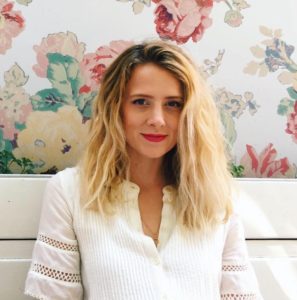
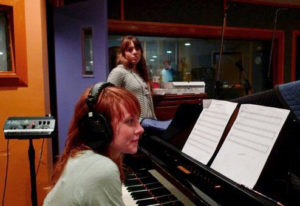
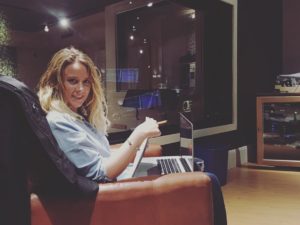
Remy Felsch

Listen to the interview (approx. 1 hr, 3 min.) or download it.
Graduated in 2016 with a major in Songwriting. Principal instrument: drums.
Position: Graphic Designer at Reside Real Estate, a tech-based real estate startup which provides marketing and support services to experience real estate agents looking to go independent of conventional agencies and establish their own brands. Remy is on a small creative team. “We’re working with each agent to create everything visual that represents the agent’s brand–digital, email, flyers, brochures, logos. Anything visual that represents that agents brand we come up with it.” Remy manages two contractors who work remotely, and also does specialty design projects that lack templates.
Overview: Remy learned Photoshop at age 10, and made a bit of money at Berklee designing album artwork and posters. He also got a work-study job with the Songwriting department, much of which involved laying out flyers. After finishing Berklee in August, he moved to Nashville, thinking about being a professional songwriting, but didn’t find success and felt he would do better as a professional drummer. He gigged a bit while working food delivery and other side jobs, but didn’t like the grind and moved home to San Francisco that December, pondering his next career move.
Remy decided to go into graphic design, since he liked it and had years of experience, and aggressively applied to jobs. He got a highly-paying internship with a similar but smaller real estate firm, which turned into a contract job. He was offered a real job there, but didn’t like the way the company was run so left in August, 2017 for a 6-month temp-to-permanent graphic design job in Raleigh, North Carolina, but got laid off after 4 months. Unable to find even side jobs there, Remy moved back to San Francisco at the end of the year, and again searched for a full-time job. Within a few weeks he was hired into his current position.
You can see Remy’s LinkedIn profile here.
Choice Quotes: “The creatively of designing a brand is super-fun to do. It’s cool coming up with a new business name and designing a logo. The most rewarding part is seeing the agent so satisfied with what we’ve come up with — people testifying that the brand helped bring them new clientele / team members.”
“That’s the thing with start ups. They just give you stuff even if you don’t think you have the qualifications. I’d never managed people, but they gave me two remote people to manage right away. It turned out to be fun and rewarding; I like the people I work with a lot.”
“Berklee is a wonderful institution to learn about music, but you can apply a lot of that to other industries. You know you love music and it’s your passion. What else do you love? Always have that plan B–that’s the best you can do for yourself. A small percentage of us really make it in music..”
“I’ve seen a lot of Berklee students who just do the graphic design for their band and are really good at it. If you’re doing it for fun and are that good at it, consider it as a career. It pays pretty well. You could do it for a music label if you want to be in the music industry.”
“In a way I’m living my dream. Not the music career dream, but I’m making a good living, working at a cool company in Silicon Valley, and am still doing music on the side. That’s what I wanted–stability, but to be able to do music on the side as well.”
See the full index of successful Berklee alumni.


 Wellington as a Berklee student. “Music education in general helps you be personable–you’re working with people, you’re playing in ensembles, working on group projects. You’re creating something together fairly often. That group-mindedness and focus benefits a whole host of careers. I’ve super-introverted and have a hard time meeting people, but working I learned to switch into an outgoing client-friendly mode. Berklee had a lot to do with that.”
 Wellington having fun with friends. He has some advice for new IT people. “Keep moving forward. It may not feel like you have huge enough experience to move on to the next position, but you often can. A skill which took you 2 minutes to learn may be very attractive to employers. On the flip side, find a company you like to work for and a role that you actually like. It’s a combination of coworkers, company culture, and the actual work. Go find the right fit.”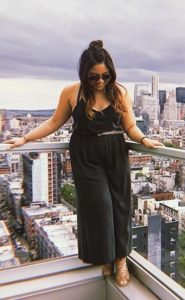
 Kristin as a beauty product writer. “A lot of publications put an emphasis on the voices of minorities. As an Asian American and a first-generation American, I bring a rare perspective. Also, as a performer growing up, I used make up. I also have eczema, a skin condition, and have a lot of knowledge of what beauty products work well. I love de-stigmatizing the condition, which can have a positive impact on someone’s life.”
 Kristin reflects on the business being a writer: “In my staff writing positions I’m paid by the hour. For freelance articles, the pay rate is very interesting and reflects the diversity of the industry. Print usually pays $1 to $5 per word, but digital can be less. When I started writing I took any assignment, but now I’m comfortable asking for more money. That said, if I’m taking on a new publication and want to build a relationship with an editor I might be willing to write an article for less. It’s less a set rate than a conversation that involves many factors.”

 One of Joe’s inventions. “My job changes really quickly–that’s what’s exciting. I do love what I do, but I have to constantly make sure I’m focusing on the right things so that I do continue to love it. It’s too easy because you’re spending time on what you don’t love–reading regulations, handling returns, which is monotonous. But if I can spend 30% of the time on what I love I call that worth it.”
 A rocket in action. “I did an analysis of model industries: trains, etc. Most hobbyists care less about speed and performance than about things being as realistic as possible in both look and function. Fin-guided rockets have to launch super fast, but real ones start off slowly–and majestic looking. The type of system I developed achieves a slow lift-off, just like the real thing. This opens up a whole new section of the hobby.”
 Joe with a friend. “Although I didn’t do it, if you’re starting a company have at least one other person to work with. You won’t have all the strengths and it’s SO hard to start a business, especially during the first few years. You’ll want someone there to go through the experience. . I moved to Nashville because I knew it would be hard, so wanted to be around friends–that’s really important.